Russian President Vladimir Putin said on Friday that his country’s efforts to establish a “security zone” along its border with Ukraine will not be a subject of negotiations with Kyiv.
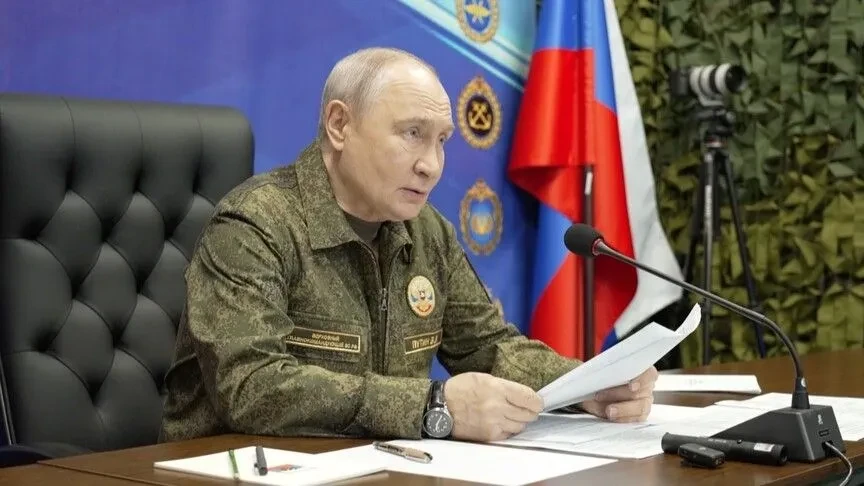
In remarks to military commanders on a visit to a command post, Putin recalled that, following Ukraine’s incursion into Russia's border region of Kursk in August 2024, Russian troops were tasked not only with pushing Ukrainian forces out of its territory but also with creating a “security zone.”
“Our goal is to ensure the absolute security of Russia’s border territories for the future, and we do not intend to make this a subject of potential peace negotiations with Ukraine,” Putin said, clad in military uniform.
Addressing the commanders, Putin said this task is being “succesfully accomplished,” noting the effectiveness of strikes against Ukrainian military-industrial complex facilities and logistics centers.
“In response to strikes by the Kyiv authorities against our industrial and fuel-and-energy facilities, the Russian Armed Forces continue to carry out strikes on enterprises of the military-industrial complex, as well as on infrastructure facilities in Ukraine,” Putin added.
He said it is essential to continue delivering “massive, coordinated” strikes against such facilities.
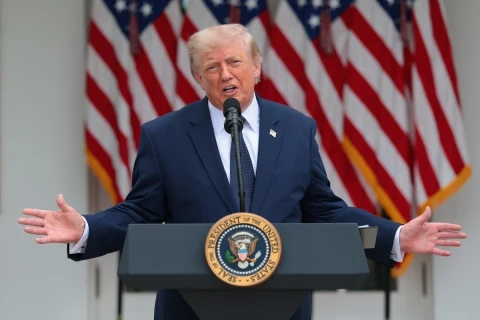
US President Donald Trump announced on Sunday a ceasefire on energy infrastructure between Russia and Ukraine. Both countries, however, have since accused each other of violating the truce.
Ukrainian President Volodymyr Zelenskyy on Thursday said Ukraine will resume the strikes after a three-day halt.
Meanwhile, the Kremlin said Russia was continuing contacts with the US concerning the truce.
Last May, Putin ordered the creation of a “security buffer zone” along the border with Ukraine after pushing Ukrainian troops out of Kursk.
In his most recent remarks, the president claimed Russia captured about 6,500 square kilometers of territory and took control of 310 settlements in Ukraine since the start of the year.
He said the capture of the Donbas region remains as a key objective, claiming about 10% of the Donetsk region and about 16.5% of the Zaporizhzhia region still remained under Ukrainian control.