




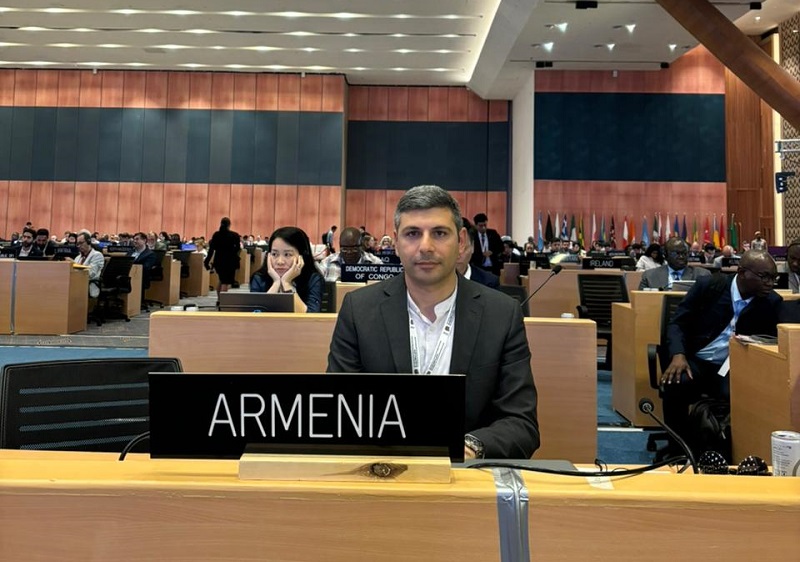
The Vishaps and the Cultural Landscape of Tirinkatar have been included in the Tentative List of the UNESCO’s World Heritage List. The decision was made at the the session of the the World Heritage Committee in New Delhi, India.
Harutyun Vanyan, the head of the Department of Protection of Historical and Cultural Monuments from of the Ministry of Education, Science, Culture and Sports, is participating as the coordinator of the convention.
Currently ca. 150 examples of these monuments are known. As a rule, they are located in secluded, water-rich, high altitude meadows in the unforested mountains, ca. 1200-3200 m above sea level. Their highest concentration (ca. 120 examples) has been detected on Mt. Aragats, in the Geghama, Sevan, Vardenis and Syunik mountains of Armenia. The limits of their macro-regional distribution are the Lake Van region in the south, the Trialeti mountain range in the north, the Erzurum region in the west and the Sevan mountain range in the east.
The vellus vishaps are the most numerous ones and they are distributed more or less equally across the macro-region. Vishaps of the hybrida type are the rarest and they are so far confined to the south-west of the Geghama mountains in Armenia. Vishaps of the piscis kind are currently lacking in the westernmost parts of the macro-region. Since the iconography of vishaps is unique, standardized and very specific, their large-scale distribution pattern testifies to the existence of a symbolic and religious common background shared by social groups across the entire region at the time of their erection.
The archaeological site as such was unknown to the scientific community until recent years, although the surrounding area is mentioned already a century ago by Armenian archaeologists Ashkharbek Kalantar and Grigor Ghapantsyan. In their studies of prehistoric water management systems on Mt. Aragats, they highlighted the importance of “Twelve canals” situated immediately east of Tirinkatar, within the gorge of the river Amberd to divert the river water to foothill villages and their summer pastures. Neither of the two early authors appears to have been aware of the existence of the archaeological site itself, located just above the source of this canal system. In the foothill town of Ashtarak, however, Ghapantsyan did hear and record stories about a certain “Maiden’s Sanctuary”, which appears in those legends as a sacred place connected with the Armenian deity Ara. Ghapantsyan was told that at the site there was “a stone throne with stone chairs,” and other stone images. Today we know that the “Maiden’s Sanctuary” is part of the wider archaeological site of Tirinkatar, first documented by the Armenian-Italian-German team in 2012.
.jpg)
.jpg)
.jpg)