


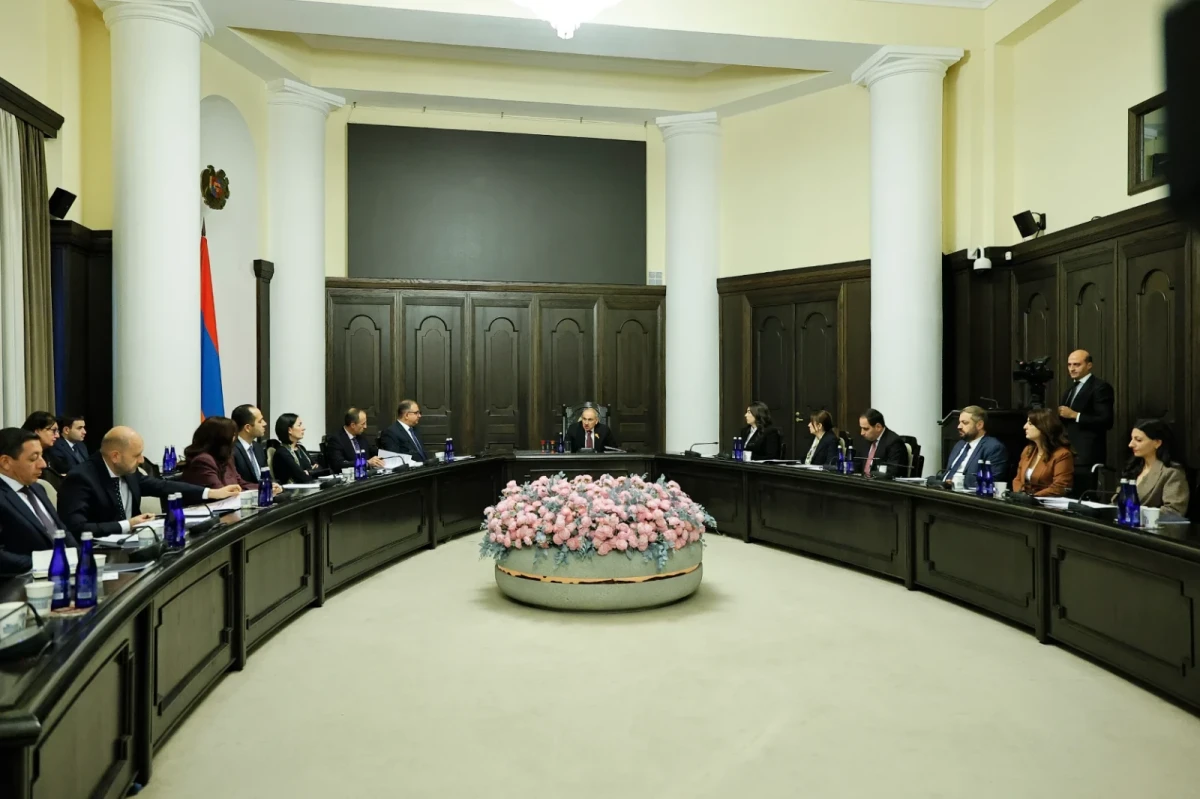
Armenian Prime Minister Nikol Pashinyan chaired a meeting of the National Commission on Issues of Persons with Disabilities. Civil society representatives also took part.
According to the Prime Minister’s Office, Pashinyan said before the discussion of the agenda that the meeting had become an annual tradition marking the International Day of Persons with Disabilities. It provided an opportunity to discuss the current situation and review the work done. He said many countries, including developed countries, faced similar challenges.
“The same problems we face in Armenia today exist everywhere. Our discussions sometimes give the impression that the world has solved a particular problem while we have stood still. That is simply not the case. Countries with the highest standards of human rights protection face exactly the same problems as Armenia,” Pashinyan said. Recognising this, he added, would help make the discussion more productive.
Pashinyan said the problems needed to be addressed through steady action. “The steps should be small, because if we set out to take big steps, they will certainly fail, including for the objective and subjective reasons I mentioned. We need to keep moving forward in small steps. The same principle applies here: the way to bring about rapid change is to take slow but steady steps. Let me quote that saying again: ‘Fast is slow, but without interruption.’”
The prime minister stressed that the Armenian government’s political commitment to addressing these problems consistently remained firm.
Participants then heard progress reports on programmes across several sectors to uphold the rights of persons with disabilities and support their inclusion. The work followed instructions the prime minister had given at the commission’s previous meeting.
Minister of Labour and Welfare Arsen Torosyan outlined the government’s policy for addressing issues facing persons with disabilities and presented its programme initiatives.
“There is, of course, much to do, but we are gradually putting these plans into practice, listening to the problems people raise and addressing them. I think 2026 has been quite productive in that respect because, alongside the changes in this sector, the changes in related fields are also very important. I particularly want to mention the introduction of health insurance. We have expanded both the range and the volume of medical services available to many of our citizens, especially those with a Group III disability or a moderate functional limitation. We have also effectively discouraged many people from seeking disability status on artificial grounds. For example, in the first ten months of 2026, we received 4,500 fewer applications for disability status and carried out about 2,000 fewer assessments than in the same period in 2025,” Torosyan said.
Torosyan recalled that benefits for persons with disabilities and all other pensioners and benefit recipients had increased from 1 April. The provision of assistive devices had also expanded. By 20 November 2026, 17,000 people had received 35,979 assistive devices. Compared with the previous year, around 1,000 more people had used the service and 2,000 more devices had been provided.
“We have also expanded the range of assistive devices we provide. Depending on the type of disability, these now include high-cost functional prostheses, innovative positioning devices and communication devices. One of our next steps will be to replace the partly digital system for providing these devices with a fully digital one. This will also make the process more transparent and efficient,” Torosyan said.
He highlighted the importance of introducing and continuing to develop the personal assistance scheme to help persons with disabilities gain independent living skills.
“In the government programme, we specifically committed to making 2,000 personal assistants available to our citizens. We currently have 457 such arrangements in place and are working on changes to improve the programme,” he said.
On employment, Torosyan said that, following an instruction at the previous meeting, the government had drawn up and approved a decision to launch an employment programme for persons with disabilities on 1 January 2027. It aims to make persons with disabilities more competitive in the labour market, encourage employers to hire them and help them secure lasting employment.
Health Minister Anahit Avanesyan said that, as part of efforts to make emergency response services accessible to persons with disabilities, the ministry had studied international practice and technologies used in other countries. She said the ministry planned to build new premises for the Health Ministry’s Republican Ambulance Service, a closed joint-stock company, over the coming year. The building will house the service’s operational management facilities, enabling it to improve management, upgrade technical infrastructure and modernise digital tools.
Avanesyan added that medical facilities completed, under construction or undergoing reconstruction as part of the current capital works programme had been or were being adapted so that persons with disabilities could enter and leave, move freely around the premises and use the toilets.
Minister of High-Tech Industry and Artificial Intelligence Davit Tadevosyan said uniform minimum requirements had been set for the official websites of state bodies, independent and autonomous bodies, and municipalities. The requirements also cover website maintenance and security. In particular, official website content must be understandable and accessible to all users, including persons with disabilities, however they access it. Tadevosyan said 39 websites, including those of the government and eight ministries, had been launched in line with the service digitisation guidelines and the requirements of the decision. A further 17 websites were under development.
Minister of Education, Science, Culture and Sport Zhanna Andreasyan said the Republican Pedagogical and Psychological Centre had developed tools to monitor and assess both physical accessibility in educational institutions and the effectiveness of reasonable adjustments for learners with special educational needs.
Monitoring is being carried out in stages in 2026 and 2027 at schools attended by pupils with special educational needs, disabilities or both. The schedule covers 1,050 institutions, with 522 in 2026 and 528 in 2027. Data were collected using standardised tools through observations, including classroom observations, document reviews and semi-structured interviews. The findings were then analysed both quantitatively and qualitatively.
“Overall, our main difficulties are still with the accessibility of the physical environment. The situation is better when it comes to reasonable adjustments, particularly their content and quality. What matters is that this information is detailed enough for us to draw up an action plan for each institution and work towards full accessibility and the provision of all necessary reasonable adjustments. Next year we will carry out this work at another 500 institutions, and I think we will then also be able to address the issues identified at each one,” Andreasyan said.
Among the achievements, Andreasyan highlighted a new programme at Yerevan State College of Humanities. “It is a programme to train Armenian Sign Language interpreters. This is a joint effort. We already have students training in this field who will help meet a demand for qualified staff that has been raised repeatedly,” she said.
Andreasyan also reported encouraging results from a pilot programme in inclusive education. “We piloted resource rooms in three schools. The results over two years show a substantial improvement in the inclusion of children with profound and severe functional limitations. We can now submit a proposal to the government on how to use this approach in individual schools,” she said.
Andreasyan also stressed the importance of involving persons with disabilities more actively in sport and culture. She said the European Deaf Wrestling Championships were under way in Tsaghkadzor, with delegations from 12 countries taking part.
Human Rights Defender Anahit Manasyan said her office’s monitoring, along with written and oral complaints and calls to its hotline, showed that several systemic barriers continued to affect the right of persons with disabilities to live independently and be included in the community. She said the monitoring had found that the legal provisions governing declarations of incapacity had yet to be revised and that a mechanism for supported decision-making had yet to be introduced.
Participants then discussed how to create accessible conditions for the social inclusion of persons with disabilities, improve and expand existing programmes and create equal opportunities. Representatives of non-governmental organisations put questions to government officials about the problems people faced and received clarifications. Participants also shared observations and proposals.
Pashinyan stressed the importance of sustained work in the areas discussed and instructed officials to continue that work, taking into account the proposals and questions raised at the meeting.