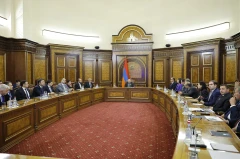

The morning session of the Prayer Breakfast 2026 forum took place in Yerevan, bringing together more than 100 senior officials, statespeople and representatives of diplomatic, business and religious circles from Armenia and abroad.
The significant event was organised by the Spiritual Club of Laypeople NGO. It aims to promote dialogue and cooperation grounded in Armenia’s historical Christian identity, peace, leadership based on moral principles and religious freedom.
The Prayer Breakfast also has the long-term aim of developing a vision of Armenia as a leading country committed to religious freedom and prosperity, with a society founded on faith, partnership, innovation and peace.
Bishop Mesrop Parsamyan of the Armenian Apostolic Holy Church welcomed those present and blessed them with the Lord’s Prayer.
Before the speeches, participants were shown a video about the khachkar preserved from the Gethsemane Chapel and Christianity in Armenia.
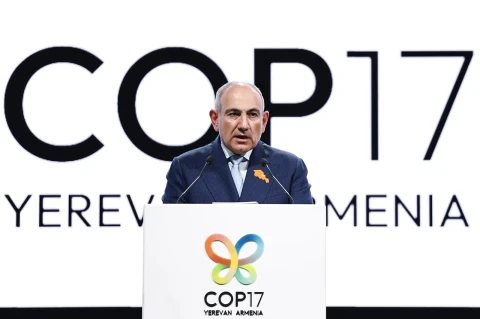
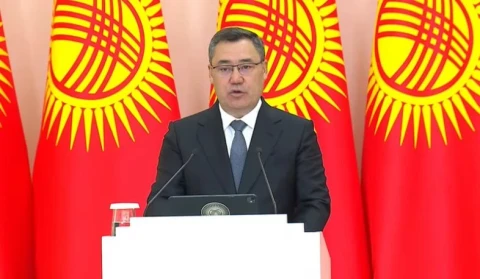
Armenian Prime Minister Nikol Pashinyan delivered the keynote address. He said the ideology of Real Armenia was based on the understanding that the Republic of Armenia, within its internationally recognised territory, was the Promised Land God had given to its people.
“There are also spiritual grounds for this. Mesrop Mashtots is buried in the village of Oshakan, in Armenia’s consolidated Ashtarak municipality, while Khor Virap, the source of our Christian faith, is located in Armenia’s consolidated Vedi municipality. The capital of our Christian faith, the centre of the Armenian Apostolic Holy Church, our holy of holies, is located in the settlement of Etchmiadzin, in Armenia’s consolidated Vagharshapat municipality. Today’s Republic of Armenia is an expression of our Christian identity, our Promised Land. We speak about our country’s spiritual life, but we must confront several important facts,” Pashinyan said.
He said the first fact was that the Armenian people had lived for around 70 years in the Soviet Union, an atheist state where the word “believer” had negative connotations. According to Pashinyan, those who placed their trust in God were rejected by the state, while believers in the Soviet Union were marginalised and isolated, relegated to the fringes of society.
“After independence, this tendency may have eased, but it has not changed completely. Even today, the word ‘believer’ carries a negative meaning, because there are believers and there are the other citizens. My conviction is that a citizen of the Republic of Armenia should believe in God, because our state is our Promised Land and our language is a pillar of our identity. Today, there is an active spiritual life in our churches and elsewhere, but the problem is that spiritual life is largely church life, confined to the church. It is very important, however, for that spiritual life to leave the church and enter the streets, homes, the marketplace, local government bodies, the government and the legislative, executive and judicial branches. A person is likely to act with much greater integrity if they believe in God. A person will be less vulnerable to corruption risks if they believe in God,” Pashinyan said.
He recalled that there was much discussion in Armenia today about fairness and justice, stressing that a judge who believed in God would be fair and that only then would the judge deliver just verdicts.
“This is important to me not only spiritually but also in terms of statehood. When we speak about values, we must understand where those values come from. Democracy existed before Christianity, but its modern form derives from Christ. When politicians travel from city to city and village to village, sharing their ideas with people, they are, in essence, emulating the work of Jesus Christ. How sincere a politician is in doing so is a matter of their relationship with God and with the people. We are constantly searching for God, yet the answer to that question lies between the lines of Holy Scripture. God is within each person. After seeing large, crowded squares, I have come to the conclusion that God is indeed within every person, but also within the people, because the people are the entity capable of encompassing God,” Pashinyan said.
He stressed that it was very important for the people to engage with this fact and regard their country as God’s dwelling place. In Pashinyan’s view, this was the foundation on which a state and society based on values could be built.
“There is much discussion about civilisation, which touches people through contemporary politics, but we all need solidarity. Views on different regulations can sometimes be radically different. The only way and place in which solidarity can exist, including between politicians, is through a conversation about God and faith, and not only about doctrinal questions. The Prayer Breakfast format is important because everyone is free to speak about their relationship with God, their spiritual feelings and their experience. That is why this is a place where solidarity can exist,” the prime minister said.
He recalled that 3 October was also National Minorities Day in Armenia and stressed that the Prayer Breakfast format allowed people to come together and pray, regardless of their religious denomination.
“Doctrinal disputes among national minorities remain outside this format, which is very important for Armenia. Complete solidarity can exist only around spiritual feelings. We must continue along this path as a path of solidarity, faith, unity and optimism, because believing in God means believing in your own people and state, believing in humanity and believing in yourself,” Pashinyan said.
At the end of his address, the Armenian prime minister read Psalm 5, entitled “Prayer for Protection: A Psalm about the Choirmaster and the Heirs”.