


Armenian Prime Minister Nikol Pashinyan has said that peace between Armenia and Azerbaijan has become a reality and must be safeguarded and strengthened every day.
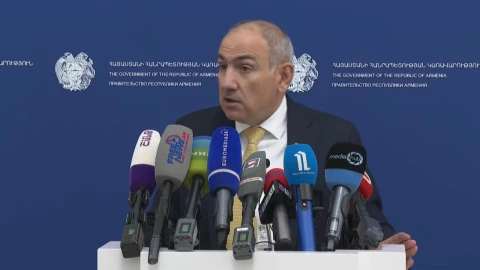
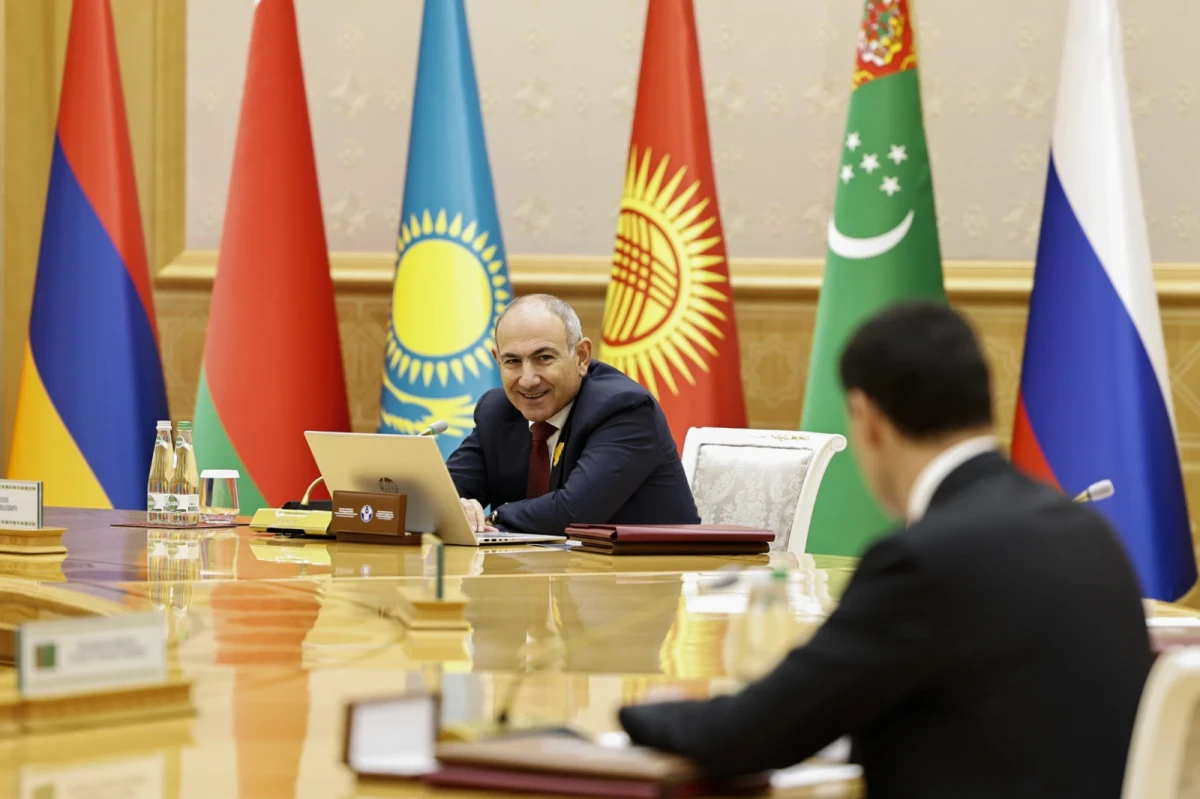
Speaking at a meeting of the Council of Heads of State of the Commonwealth of Independent States (CIS) in Turkmenistan on October 9, Pashinyan said Armenia and Azerbaijan had achieved what once seemed impossible, thanks to their efforts and the support of international partners.
“Peace between Armenia and Azerbaijan is an established fact,” Pashinyan said, noting that there had been no casualties or injuries resulting from exchanges of fire between Armenians and Azerbaijanis for more than two years, unlike the preceding three decades.
He said the Azerbaijani railway had been open to Armenian cargo for almost a year, bilateral trade between the two countries had begun, and a 12-kilometer section of their state border had been delimited and demarcated.
Pashinyan also highlighted the upcoming implementation of the TRIPP project on Armenian territory, which he said would unblock communications between Armenia and Azerbaijan, including connections between Armenia’s northern and southern regions through the territory of Azerbaijan’s Nakhchivan Autonomous Republic.
The project would also connect mainland Azerbaijan with Nakhchivan through Armenia, based on respect for the sovereignty, territorial integrity and jurisdiction of states, he said.
According to the prime minister, the initiative would open new international logistics routes from east to west and from south to north, including a railway connection between the Persian Gulf and the Black Sea through Iran, Azerbaijan’s Nakhijevan Autonomous Republic, Armenia and Georgia.
“This shows that the implementation of the TRIPP project is beneficial for all countries in the region, including CIS countries, which will gain new logistical opportunities,” Pashinyan said.
He added that the opening of the state border between Armenia and Turkey and the restoration of connecting road and railway infrastructure were also expected.
Alma-Ata Declaration as the Foundation for Peace
In his speech, Pashinyan emphasized the role of the Alma-Ata Declaration of December 21, 1991, in establishing peace between Armenia and Azerbaijan.
He recalled that the declaration, signed by 11 former Soviet republics, recognized and respected their territorial integrity and the inviolability of existing borders while recording the dissolution of the Soviet Union.
Pashinyan said the declaration had played a key role in the peace process and was incorporated into the text of the initialed agreement on peace and the establishment of interstate relations between Armenia and Azerbaijan.
In 2024, Armenia and Azerbaijan signed and ratified regulations governing the joint activities of their commissions on the delimitation of the state border. The document established the Alma-Ata Declaration as a fundamental principle for the delimitation process, he noted.
The agreement on peace and the establishment of interstate relations between Armenia and Azerbaijan was initialed on August 8, 2025, during a peace summit hosted by US President Donald Trump at the White House.
Pashinyan said that after the 2020 war, it had become clear that the only viable way to achieve peace between Armenia and Azerbaijan was to build a framework based on the principles of the Alma-Ata Declaration.
He also highlighted the role of Russian President Vladimir Putin in achieving the November 2020 ceasefire, while noting that the November 9 statement had not, in itself, resulted in peace.
According to Pashinyan, the revival of the Alma-Ata Declaration took place on October 6, 2022, when he and Azerbaijani President Ilham Aliyev reaffirmed its principles at a quadrilateral meeting in Prague initiated by French President Emmanuel Macron and European Council President Charles Michel.
Humanitarian Issues Remain Unresolved
Pashinyan acknowledged that peace between Armenia and Azerbaijan was not perfect and that several humanitarian issues remained unresolved.
These include determining the fate of missing persons, demining and issues related to individuals held in detention, he said.
The prime minister also noted that negative sentiments occasionally intensified in both Armenia and Azerbaijan, including at the official level. However, he said such developments no longer called into question the existence of lasting peace.
“More than 30 years of conflict cannot be switched off in an instant with the movement of a switch,” Pashinyan said, emphasizing that time and consistency would be required.
He stressed that the peace achieved through the efforts of the two countries’ leaders and with the support of international partners served the interests of the peoples of Armenia and Azerbaijan, strengthened their independence and offered future generations a historic opportunity for peaceful coexistence, cooperation and good-neighborly relations based on shared interests.
Pashinyan said Armenia had chosen a strategy of moving forward toward signing and ratifying the peace agreement with Azerbaijan.
He expressed confidence that continued cooperation would lead to the ultimate goal of signing and ratifying the peace treaty between the Republic of Armenia and the Republic of Azerbaijan.
The meeting of the CIS Council of Heads of State was followed by an expanded session, during which documents on cooperation within the CIS framework were signed.